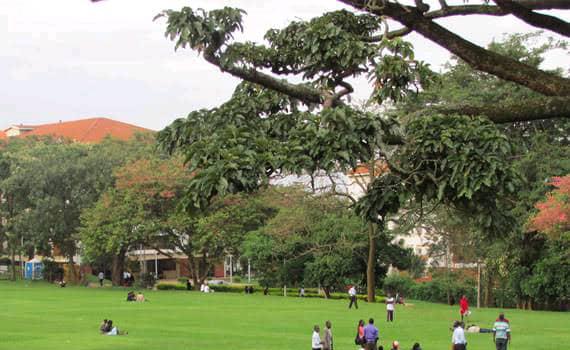
Seeing an impressive composition of greenery which seldom changes throughout the year is quite unheard of at most campuses in Uganda, but this is not the case at Makerere University.
A green and clean environment is indispensable for the survival of human life in any setting because abundant greenery purifies the air we breathe, and has a soothing impact on human beings.
Taking a walk around the premises of the University, something has to certainly catch your attention, even for one who is absent minded- the extra ordinarily green environment.
The environment is perfectly green, the likes of which can never be found on the premises of any institutions of higher learning in Uganda, thanks to the University Department of Estates and Works that keeps the campus green.
The extremely good looking green grass, meticulously trimmed flowers and plants gives the environment a fascinating look, forming a beautiful scenery, and a perfect environment for relaxation and fun.
Coupled with ever flying birds in the blue sky like piedwaghtels, cattle eaglets, herons and marabou storks, Makerere University environment is a place like no other. Besides, the birds also incidentally pick some of the dirt, hence keeping the environment perfectly clean.
The monstrously massive and self-supporting natural trees are explicitly noticeable everywhere on campus. The University environment is an embodiment of several tree species with thick branches especially around the quarry road to Livingstone hall, which form a perfect ecosystem for the survival of birds, insects and small animals.
Greatly astonished by how the Estates Department has attained a trump card in maintaining the university green, something that has won it a peculiar label “green campus”, I conducted a phone interview with Darius Muwanguzi, the department’s assistant manager.
He divulged that the university undertook a carefully conceived plan of drafting a policy which makes it mandatory for one to seek permission from the administration before making a decision to cut any trees at the campus premises.
This calculated policy according to Muwanguzi has curtailed the degradation of the campus environment by preventing unauthorized personnel from cutting natural trees, something that has ensured their longevity.
“That policy would limit people from cutting down trees, in case one cut a tree without seeking permission with clear reasons, it would be a disciplinary case and if she/he was a staff member, they would stand to lose their job,” Muwanguzi explains.
He elaborated at length that the department has also undertaken important strides to enrich the already green environment by planting more trees, something that is done to replace the cut ones, in case of any new developments like construction.
Asides posing a danger to the green environment, tree cutting also puts the university’s magnificent buildings at a risk of being grounded by the falling tree branches, another threat to the campus’ beautiful scenery.
Atuhaire Dagan, a year-three student at the College of Agriculture and Environmental Sciences (CAES) who is also an environmental activist told this publication that natural trees at Makerere University are vitally relevant in rainfall formation and also help to defuse the threat posed by air pollution.
“Long dry spells are unheard of at the university and even the areas around. Rains in and around campus fall abundantly because of the trees you see here,” Clarifies Atuhaire.
She also explained that these gigantic trees provide perfect shades under which students sit and revise books, on top of providing a perfect abode and food for small insects, animals and birds, hence ensuring the survival of the natural ecosystems around the campus.
Note has to be taken that the abundance of trees and greenery purifies the air we breathe by absorbing dangerous gases and emitting oxygen, a view also shared by Atuhaire.
Dr. Mathias Behangana, an environmental conservationist and a senior lecturer at the Department of Environmental Management at the University in a phone interview with this publication urged the government of Uganda to borrow a leaf from the Department of Estates and Works at Makerere in terms of strict policies to conserve the environment.
“When you look at laws set aside by government to protect the environment from degradation, you will be convinced that nothing will happen to our natural forests, our wetlands but enforcement is the problem. I think they should come to Makerere for lectures on this,” he says.
Despite several encroachments like the massive cutting of trees in December 2019 which irked environmentalists, the university environment has defied all odds and remained extremely green.