FAMReports News Desk | August 2025
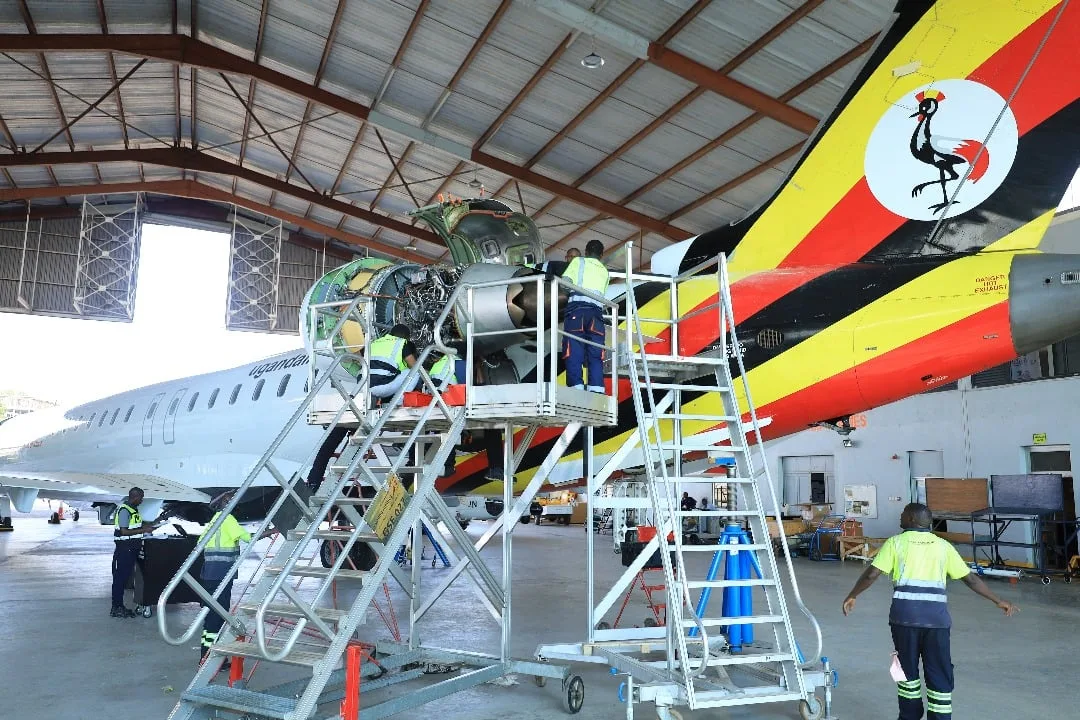
Uganda Airlines has marked a historic technical milestone after its Approved Maintenance Organisation (AMO) successfully performed its first in-house engine change on a CRJ900 aircraft, registered as 5X-KNP.
The achievement comes just days ahead of the national carrier’s sixth anniversary on August 28, 2025.
The complex operation involved replacing the aircraft’s left engine with a brand-new General Electric CF34-8C5 unit. The removed engine is scheduled for modifications at the manufacturer and is expected to return for installation on the right side, ensuring both engines undergo the required upgrades.
While engine replacements are routine in global aviation, this milestone is significant for Uganda Airlines as it represents the first time the procedure has been conducted entirely by its AMO team since receiving certification from the Uganda Civil Aviation Authority (UCAA) in March 2024.
“This is a milestone achievement for our airline, our country, and the region,” said Peter Emuge, Head of Maintenance and Engineering at Uganda Airlines. “Until now, such operations had to be carried out abroad. With our AMO, we now have the capacity to handle top-level technical work locally using Ugandan engineers.”

Emuge added that although an engine change typically takes 48 hours, the airline allocated more time for this first attempt to provide young engineers with comprehensive learning exposure. “Outsourcing such work abroad often exceeds USD 100,000, excluding ferrying and handling expenses. Performing it here saves the airline and the country significant money,” he said.
Building Local Expertise
Uganda Airlines has heavily invested in developing local engineering talent. The AMO employs experienced international engineers, while 18 graduate trainees from Soroti Flying School and universities including Makerere receive hands-on mentorship aimed at attaining aircraft maintenance licenses within three years.
“When Uganda Airlines restarted, some doubted whether Ugandans could handle technical operations,” said CEO Jenifer Bamuturaki. “Today, our engineers have proven themselves. We are training the next generation of managers, pilots, and engineers to make this airline fully Ugandan-led.”
Bamuturaki also highlighted the growing role of women in aviation engineering. Graduate trainees are actively involved in engine projects, and women serve as development engineers, materials managers, and records officers. “Six years ago, many of our engineers were still in training. Today, young women are taking up technical roles and excelling,” she said.
Operational and Financial Impact
The airline’s shift to in-house maintenance has significantly reduced costs, according to Joseph Lukwago, Head of Line Maintenance. “Previously, Uganda Airlines spent between UGX 800 million and 1 billion monthly on outsourced maintenance. By taking over operations, we have drastically cut expenses,” he said.
Lukwago noted that flying the aircraft abroad for the engine change would have cost approximately USD 10,000 in fuel plus over USD 100,000 for the procedure. Conducting the operation in Uganda saves millions. He added that the maintenance team comprises around 45 staff, including engineers, assistants, and trainees, with six women directly involved in the engine change, reflecting growing gender inclusion in aviation engineering.
Growth and Strategic Outlook
The successful engine change underscores broader progress for Uganda Airlines, which has expanded its operations and strengthened sustainability. Passenger numbers grew from 70,000 in 2019 to over 419,000 in the last financial year, bringing cumulative figures since the airline’s relaunch to more than 1.2 million.
“We started with five flights daily in 2019. Today, we operate nearly 59 flights a day, more than 580 weekly,” said Bamuturaki.
“Our cargo operations are expanding, and the London route has been a breakthrough in revenue, recognition, and tourism promotion.”
Also Read: Apply Now: Fully Funded Mastercard Foundation Scholars Program at the University of Pretoria 2025
Bamuturaki also addressed Uganda Airlines’ financial growth. Annual revenue stood at Shs 28.5 billion in 2019 and has grown consistently, demonstrating resilience despite economic shocks such as the COVID-19 pandemic. She emphasized the airline’s ambition to become a net contributor to government revenue through continued investment, partnerships, and training.
Spare Parts and Global Supply Chain Challenges
Uganda Airlines acknowledges global challenges in sourcing spare parts due to post-COVID-19 supply chain disruptions. Emuge reassured the public that the airline has mitigation strategies, including predictive maintenance and supplier partnerships.
“Parts delays are due to global supply-demand imbalances, not lack of parts,” he said, noting that CRJ aircraft engines are readily available. Bamuturaki clarified that pre-ordered spare engines allow operations to continue while rotations for maintenance take place.
She also appealed for national support, saying, “It is disappointing when Ugandans undermine their own national airline. Unlike other countries where citizens proudly support their carriers, we often face unnecessary negativity. The success of Uganda Airlines benefits the whole economy.”
For Uganda Airlines, the first in-house engine change represents more than a technical achievement—it is a symbol of national progress. “Uganda Airlines is still young, but the progress we have made shows what is possible,” Bamuturaki said. “We are building something that will serve generations to come.”
Trusted Stories. Informed Voices. Impactful Reporting.
🌐 www.famreports.com | 📧 info@famreports.com |
📲 @FAMMediaGroup