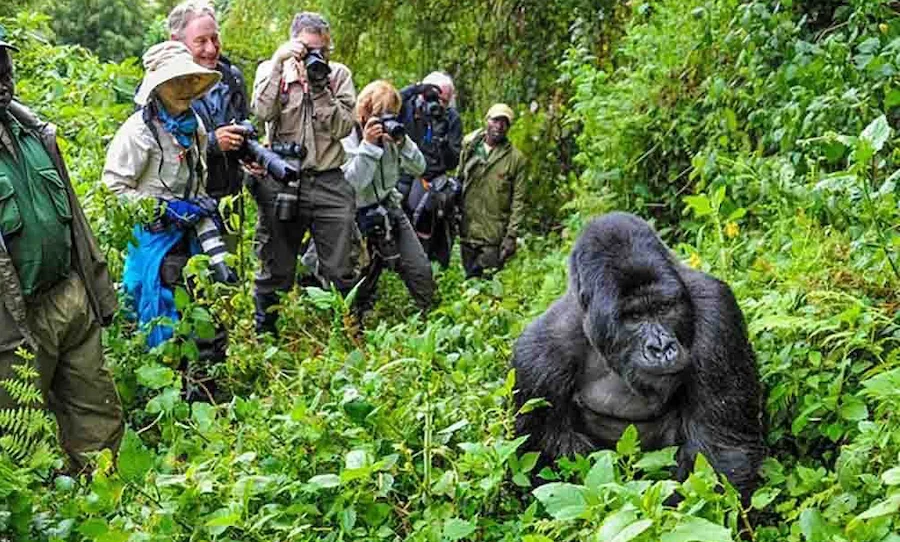
The Uganda Wildlife Authority (UWA) has announced plans to habituate chimpanzees for tourism and research in Bwindi Impenetrable Forest National Park, traditionally known for its world renowned mountain gorilla tracking experiences.
This initiative follows the conclusion of a 35 day scientific chimpanzee census, the first of its kind in the park, conducted by the Jane Goodall Institute JGI. Launched on May 1 2025, the census provided concrete evidence of a previously unconfirmed coexistence between chimpanzees and mountain gorillas within the same ecosystem.
Speaking at the decommissioning event held in the Rushaga sector of Bwindi, Mr Nelson Guma, the Bwindi Mgahinga Conservation Area Manager, confirmed the landmark findings.
“We are grateful to our development partners at the Jane Goodall Institute, whose scientific census confirmed the existence and importantly, the coexistence of chimpanzees and mountain gorillas in Bwindi Impenetrable National Park,” said Mr Guma.
According to Guma, the data offers a significant opportunity for UWA to diversify Uganda’s primate tourism portfolio by habituating at least one chimpanzee group. This would not only attract more visitors but also expand research possibilities in one of Uganda’s most ecologically significant landscapes.
“This kind of coexistence between the two great apes is highly unusual in Uganda,” Mr Guma added. “It offers immense potential to further conservation science and ecological tourism.”
The census also provided a platform for capacity building. Guma praised JGI for training UWA rangers in the use of modern census technology, which he said will improve data accuracy and conservation decision making in the future.
“The trained staff will now serve as trainers of trainers,” he said. “This will enhance local capabilities to carry out scientific research and ensure evidence based planning for the conservation of these endangered species.”
Mr James Byamukama, Executive Director of the Jane Goodall Institute Uganda, emphasized the significance of the project, which cost approximately 150000 dollars to implement.
“This is the first census aimed at determining the size and distribution of chimpanzees in Bwindi,” he said. “Our goal was to generate evidence that can guide future management and conservation decisions. These findings mark a turning point in Bwindi’s conservation narrative.”
Byamukama added that the results elevate Bwindi Sarambwe’s global status as a unique habitat where two endangered great apes, mountain gorillas and chimpanzees, coexist with humans, making it the only such ecosystem on Earth.
Recommended: BoU Tightens Capital Requirements to Strengthen Banking Sector Resilience
The new data is also expected to shift the branding of Bwindi Impenetrable National Park from being solely a gorilla sanctuary to a more complex and biologically diverse destination. Experts believe that this repositioning could attract a broader demographic of ecotourists, researchers, and conservation enthusiasts.
Located in southwestern Uganda and designated a UNESCO World Heritage Site, Bwindi Impenetrable Forest spans over 321 square kilometers and is home to nearly half of the world’s remaining mountain gorillas. The introduction of chimpanzee habituation could further bolster the park’s ecological and economic value.
As Uganda aims to increase its wildlife tourism revenues and promote biodiversity conservation, the successful integration of chimpanzee tourism in Bwindi would represent a new era in sustainable tourism development, one grounded in science, community engagement, and the preservation of natural heritage.