FAMReports News Desk | March 2026
The Government of Uganda has announced plans to construct a mega international airport in Mbarara, Western Uganda, a project that could become the largest aviation facility in the country once completed.
If implemented, the proposed airport would become Uganda’s third international airport after Entebbe International Airport and Kabalega International Airport. The announcement has sparked excitement as well as debate among citizens, with supporters welcoming the development while critics question the feasibility of such a large scale infrastructure project in the current economic climate.
Location and Strategic Position
The proposed airport will be located in Mbarara, overlapping into Mbarara District, with the core infrastructure centered on the existing Nyakisharara Airstrip. The site lies within Greater Kashari County along the Mbarara Ibanda road and extends toward the Mbarara Kasese road.
The location is approximately 11 kilometers from Mbarara city center and about 284 kilometers southwest of Kampala, Uganda’s capital. Authorities believe the strategic positioning will strengthen Western Uganda’s connectivity and enhance its economic potential.
Size and Technical Specifications
According to government officials, the mega airport project will cover approximately 21 square kilometers, making it one of the largest infrastructure developments ever planned in the region. The scale of the project means that residents currently occupying parts of the proposed land will have to be relocated and compensated.
Also Read: EAC Intra Regional Trade Rises to 40.3 Billion Dollars as Leaders Meet at 25th Heads of State Summit
President Yoweri Kaguta Museveni revealed during the Tarehe Sita celebrations held in Kabale in February 2026 that the airport will feature three major runways.
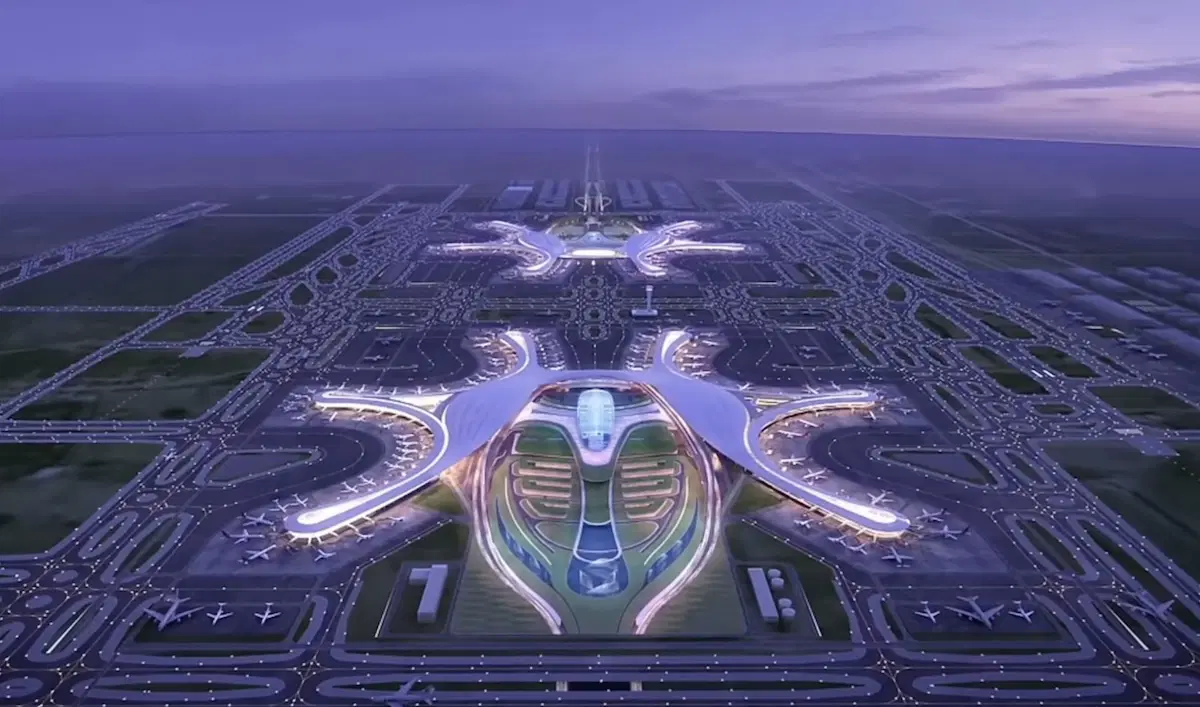
Two of the runways will be 5.5 kilometers long and positioned parallel to each other, primarily designed for large commercial aircraft and cargo operations. At 5,500 meters, they would rank among the longest commercial runways globally.
A third runway measuring 3.7 kilometers will be reserved for VIP and specialized aircraft operations.
An artistic impression of the project was presented to Prime Minister Robinah Nabbanja on March 6, 2026 by potential developers. The proposed design reportedly draws inspiration from Chengdu Tianfu International Airport, one of China’s modern aviation hubs.
Strategic Purpose of the Airport
According to President Museveni, the airport is envisioned as a major international refueling hub and cargo transit center connecting long haul flights between South America and Asia.
Prime Minister Nabbanja explained that the facility is intended to facilitate trade between China and South American countries including Argentina and Brazil. Officials estimate that the airport could reduce travel time for cargo and passenger routes between the two regions by up to 15 hours.
Beyond global logistics, the airport is also expected to boost tourism in Western Uganda. The proposed site lies within close proximity to major attractions such as Lake Mburo National Park, Rwenzori Mountains and Queen Elizabeth National Park.
Construction and Funding Model
The project is expected to be implemented under a Build Operate Transfer structure, commonly referred to as BOT. Under this model, private developers will finance the construction of the airport, operate it for an agreed period to recover their investment through user fees, landing charges, cargo services and related commercial activities, before transferring ownership to the government.
Recommended: Women in Digital Careers Urged to Prioritize Mental Health and Skills to Unlock Opportunities
A firm identified as Base Seven Company also known as Base 7 or B7 has been mentioned as the lead developer for the project. Additional partners may join during later stages as planning progresses.
As of March 2026, the government has not released an official estimate of the project’s cost.
Impact on Local Communities
The development will require significant land acquisition and may lead to the displacement of residents living around the Nyakisharara area. In a letter dated February 11, 2026, President Museveni directed Prime Minister Nabbanja to oversee the relocation and compensation of affected communities.
The project will also necessitate adjustments to existing infrastructure, including the relocation of sections of the Mbarara Ibanda road via Bwizibwera. The proposed alternative route is expected to run through Mbarara Keigoshora Bwizibwera and will be financed by the developer.
Economic Opportunities
Despite the concerns surrounding displacement, the project is expected to generate numerous economic opportunities for the region. Experts believe the airport could stimulate investment in hospitality, logistics, trade and housing developments.
Hotels, cargo terminals, transport services and commercial centers are anticipated to emerge around the facility, creating employment and accelerating urban growth in the greater Mbarara area.
As Uganda continues to position itself as a competitive destination for foreign direct investment, large infrastructure projects such as the proposed Mbarara mega airport are seen as part of the country’s broader strategy to strengthen connectivity, expand trade networks and sustain economic growth.
Trusted Stories. Informed Voices. Impactful Reporting.
Website: www.famreports.com
Email: info@famreports.com
Social handle: @FAMMediaGroup