FAMReports News DeskApril 2026
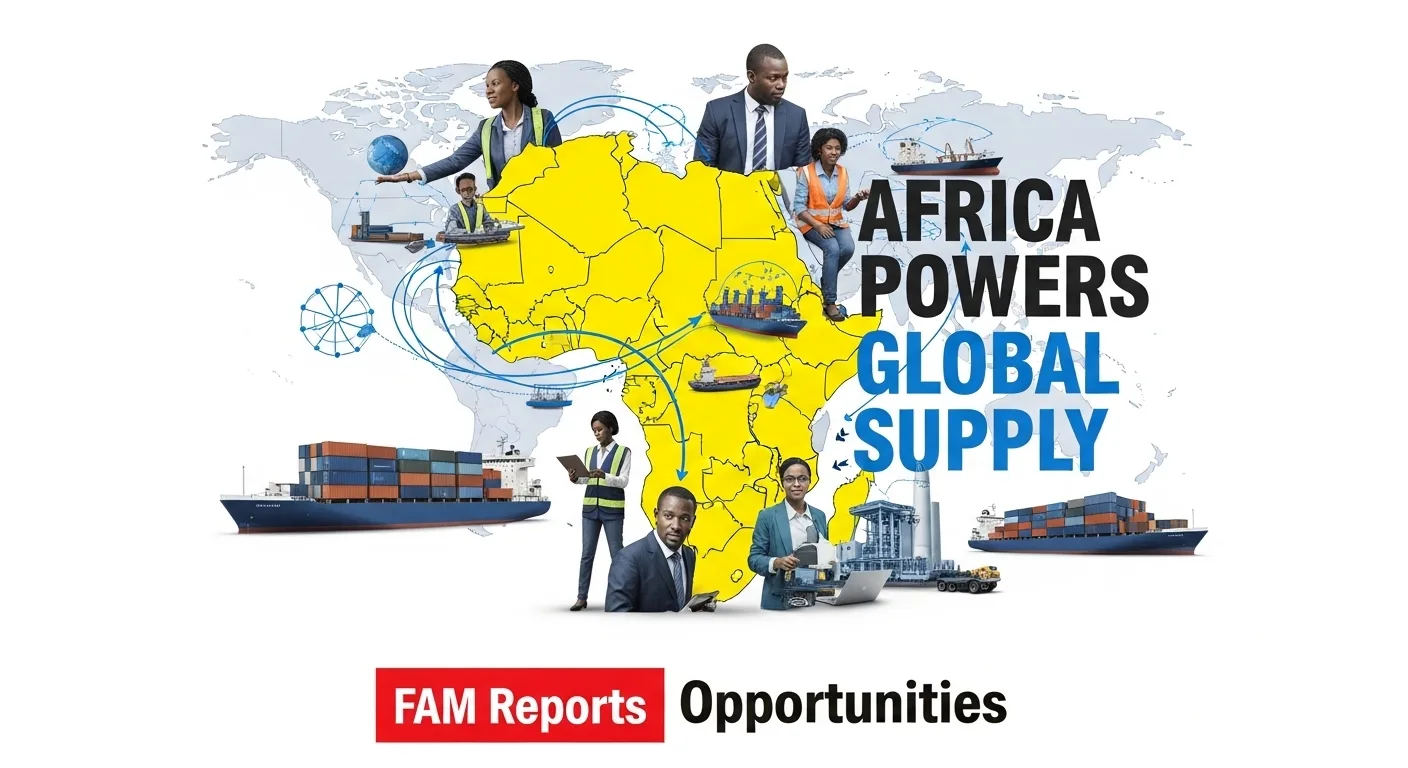
For decades, Africa has been visually and intellectually diminished by the way it is portrayed on global maps, in classrooms, and across business narratives. This is not merely a harmless mistake in geography. It is a systemic underestimation with far reaching consequences for global trade, investment decisions, and supply chain strategies.
Here is a fact that continues to surprise even seasoned policymakers and investors. The African continent covers approximately 11.7 million square miles. Within that space, one can fit the United States, China, India, Japan, and most of Europe combined, with room to spare. Yet Africa is routinely depicted as smaller than it is, often discussed as if it were a single country rather than a continent of 54 distinct nations, each with its own economic systems, regulatory frameworks, and production capacities.
The Power of Perception in Global Economics
Maps are not neutral. The commonly used Mercator projection dramatically shrinks regions near the equator while enlarging those closer to the poles. Africa, sitting squarely along the equator, is one of its greatest victims. Over time, this visual distortion has translated into a cognitive one, shaping how Africa is perceived in boardrooms, supply chain models, and global risk assessments.
Also Read: Uganda Seeks to Close Trade Gap with Egypt Through Strategic Partnerships
This misrepresentation has created an enduring myth of Africa as a peripheral market rather than a central pillar of global production and consumption. In reality, Africa is not one market. It is a constellation of massive and diverse economic ecosystems spanning deserts, rainforests, savannahs, and temperate zones.
Underestimated Markets and Missed Opportunities
One of the most immediate consequences of Africa’s perceived smallness is the underestimation of its market size. Businesses often lump the continent into a single category, overlooking the fact that Nigeria alone has a population exceeding 220 million people, while countries like Ethiopia, Egypt, the Democratic Republic of Congo, and Tanzania each represent significant consumer and labor markets.
This simplification leads multinational firms to under invest, under plan, and under prepare for Africa’s economic scale. Supply chains designed with narrow assumptions fail to capture opportunities in manufacturing, processing, logistics, and regional trade integration.
A Global Pillar in Commodities and Energy
Africa’s true scale is particularly critical in commodities, agriculture, and energy. The continent holds vast reserves of minerals essential to modern economies, including cobalt, lithium, copper, and rare earth elements crucial for renewable energy and electric mobility.
Agriculturally, Africa contains more than half of the world’s uncultivated arable land. Its multiple climate zones allow for year round production of diverse crops, positioning the continent as a future anchor of global food security. Yet outdated narratives continue to frame Africa as food insecure rather than food capable.
Recommended: Turning Vision into Reality: How Entrepreneurs Can Execute Ideas Successfully
In energy, Africa’s geography offers enormous solar, wind, hydro, and gas potential. Understanding the continent’s size is key to appreciating how energy corridors, transmission infrastructure, and cross border projects can reshape global energy markets.
Supply Chains and the Cost of Oversimplification
For professionals working in global supply chains, Africa’s misrepresentation creates strategic blind spots. You cannot fully understand production potential, climate resilience, logistics complexity, or cultural diversity without first appreciating the continent’s vast physical scale.
Transport times across Africa rival those of entire continents elsewhere. Climate conditions vary dramatically between regions, influencing crop cycles, mining operations, and infrastructure resilience. Treating Africa as a monolith leads to flawed sourcing strategies and fragile supply chains.
As global companies seek to diversify away from over concentrated sourcing hubs, Africa’s scale makes it uniquely positioned to absorb and sustain diversified production. But this opportunity can only be realized if the continent is understood accurately.
Rewriting the Narrative
Textbooks have shrunk Africa. Media coverage often oversimplifies it. Business frameworks frequently overlook it. These narratives no longer align with global economic realities.
The future of global sourcing, commodity diversification, and resilient supply chains depends on a continent that is far bigger and far more complex than most people realize. Africa does not fit neatly inside the world’s outdated narrative. The truth is more compelling. The world fits inside Africa.
Trusted Stories. Informed Voices. Impactful Reporting.
Website: www.famreports.com
Email: info@famreports.com
Social handle: @FAMMediaGroup