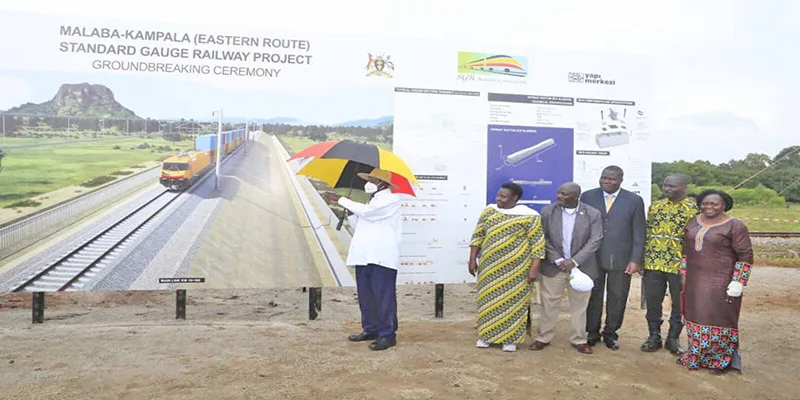
Uganda has released $75 million to Turkish contractor Yapı Merkezi to commence preliminary works on the country’s long-awaited Standard Gauge Railway (SGR).
The Malaba–Kampala line, stretching 272 kilometres from the Kenyan border to the capital city, has been in the pipeline for nearly a decade. With an estimated price tag of €2.7 billion ($2.9 billion), it is one of Uganda’s most ambitious infrastructure undertakings and a key component of both the East African Community (EAC) Railway Master Plan and the Northern Corridor Integration Projects. The route will traverse 10 districts, including Tororo, Jinja, and Mukono, linking Uganda more seamlessly to Kenya’s transport network and the wider Indian Ocean trade routes.
The decision to release funds marks a turning point after years of uncertainty. Previous efforts to secure financing from Chinese lenders collapsed, stalling the project and leaving Uganda’s regional competitors to forge ahead with their own standard gauge initiatives. By opting to front its own resources, the Ugandan government is signaling renewed determination to deliver the long-promised railway, although questions remain over how the remaining billions will be financed.
ALSO READ: SMEs in Focus: Absa Rolls Out Nationwide Business Capacity Forums
“The project is not just about rails and trains; it is about creating opportunities across the economy,” said Perez Wamburu, the SGR project coordinator, at a press briefing in Kampala on August 26. “We are building a corridor that will spur industries, create jobs, and cut the cost of doing business.”
Local Participation and Economic Spillovers
Officials emphasized that the railway’s benefits will not be limited to transport efficiency. At least 40 percent of the project value has been ring-fenced for Ugandan suppliers and contractors, ensuring that domestic companies in cement, steel, logistics, labour, and other services capture a significant share of the economic activity.
The early release of funds will be channeled towards surveys, engineering designs, and other preparatory works. This phase is expected to create thousands of short-term jobs, with longer-term employment opportunities anticipated once full-scale construction begins.
Land acquisition—a key hurdle in many of Uganda’s infrastructure projects—has also advanced. Government data shows that 150 kilometres, or about 55 percent of the planned route, has already been secured, mainly up to Buikwe District. Compensation to project-affected persons stands at Shs 300 billion ($80 million), nearly half of the Shs 610 billion set aside.
This progress is crucial, as past delays have been partly linked to disputes with landowners and delayed compensation payments. Officials say clearing this bottleneck will smooth the path for construction to begin without major disruptions.
The railway is being positioned as a strategic intervention to address longstanding bottlenecks in Uganda’s transport system. Currently, the majority of imports and exports move by road along the congested Northern Corridor linking Mombasa Port to Kampala. This reliance on trucking is costly, with freight charges estimated at nearly double those in countries with efficient rail systems.
Moreover, Uganda’s existing metre-gauge railway is outdated and increasingly unreliable, limiting its capacity to serve as a viable alternative. The SGR, with its modern track and higher speed capacity, is expected to cut cargo transit times drastically and reduce freight costs, making Ugandan goods more competitive both regionally and internationally.
Regional Race for Connectivity
Uganda’s renewed commitment comes at a time when its neighbours are making visible progress on similar projects. Kenya has already constructed more than 600 kilometres of standard gauge railway between Mombasa and Naivasha, though plans to extend the line towards Malaba—where it would connect with Uganda’s section—have stalled due to financial constraints.
Meanwhile, Tanzania has moved aggressively, building an extensive SGR corridor from Dar es Salaam to its inland markets. Like Uganda, Tanzania has relied on Turkish and Chinese contractors, and its faster pace has raised concerns in Kampala about losing regional competitiveness.
While the initial $75 million injection demonstrates political will, financing the remaining billions remains a pressing challenge. Government has not publicly disclosed its strategy for closing the funding gap, though officials have hinted at a mix of state resources, private investment, and possible future bilateral arrangements.
The Standard Gauge Railway is seen not just as a transport project but as a test of Uganda’s ability to deliver large-scale infrastructure. Success would mean not only faster and cheaper cargo movement but also enhanced regional integration, industrial growth, and greater competitiveness for Ugandan businesses.