FAMReports News Desk | December 2025
A new peace agreement between the Democratic Republic of Congo and Rwanda has been signed in Washington, with US President Donald Trump positioning himself as the chief broker of stability in one of Africa’s most volatile regions. While the ceremony projected the image of restored unity, the underlying dynamics suggest a strategic opportunity for Washington to deepen its economic footprint in the resource rich Great Lakes region.
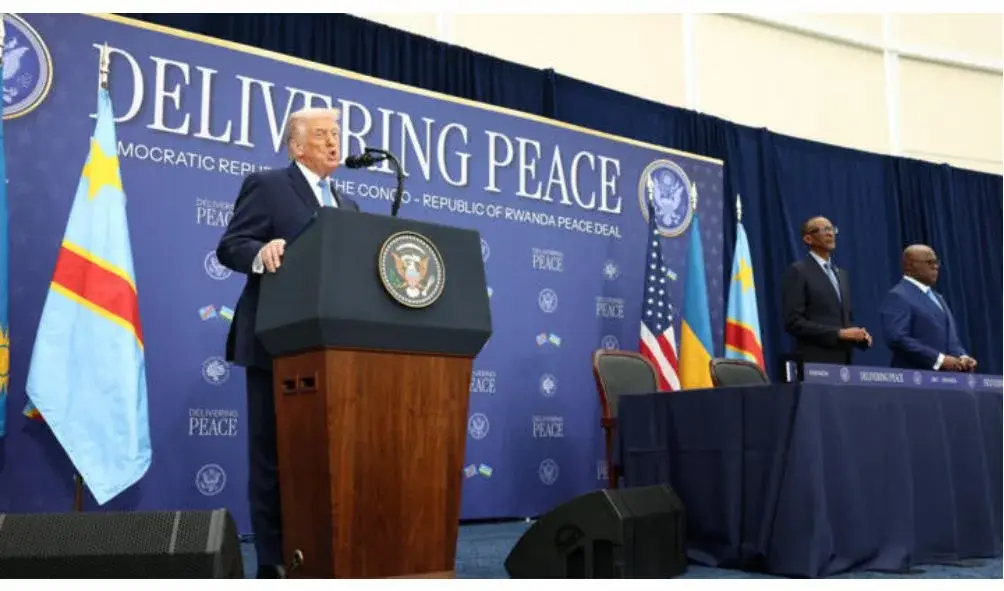
President Felix Tshisekedi of DR Congo and President Paul Kagame of Rwanda attended the signing ceremony at the Donald J Trump Institute of Peace, supported by leaders from Kenya, Angola, Burundi, Togo and Uganda. Though diplomatic in form, their stiff body language and absence of a handshake signaled ongoing tensions.
The deal endorsed in Washington was not new. It was the public affirmation of an agreement reached months earlier, one that has not stopped violence or slowed the advance of the M23 rebellion in eastern DR Congo.
Trump, however, seized the moment to cast himself as the architect of a new era in Central African stability — and a key beneficiary of the economic opportunities that peace might unlock.
A Ceremony Wrapped in Diplomacy but Driven by Economic Strategy
In his address, Trump framed the peace pact as a “historic day”, praising both leaders and promising American investment. His comments went further than diplomatic goodwill. He openly linked peace to economic extraction, an unusual admission for a sitting US president.
“We’re going to take out the rare earth, take out the assets, and pay,” Trump declared. “Everybody’s going to make a lot of money.”
This statement exposed the economic lens through which Washington views the conflict. With DR Congo holding an estimated $25 trillion worth of mineral reserves — including global strategic materials like cobalt, copper, lithium, manganese and tantalum — the region’s stability provides fertile ground for foreign commercial interests.
Trump’s framing appeared to turn the peace process into a gateway for American corporations to expand their footprint in Africa’s mineral economy. For observers, the ceremony symbolised not only geopolitical engagement but also the opening of new commercial corridors between US companies and some of the richest mineral deposits in the world.
Clashes Undermine the Celebration
Hours before the ceremony, fighting resumed in North Kivu and South Kivu. DR Congo’s military accused the M23 rebels of attempting to derail the peace process, while M23 claimed government forces breached ceasefire commitments by launching fresh offensives. Humanitarian groups documented new displacement, underscoring the gap between diplomatic optimism and ground realities.
M23 did not attend the Washington signing. The group is engaged in a separate, still fragile negotiation process mediated by Qatar. Without their buy in, experts warn that no peace agreement can fundamentally shift the trajectory of the conflict.
Fresh fighting was also reported near major towns recently taken by M23, raising questions about whether the Washington ceremony will have any practical impact.
Rwanda’s Deep Security Concerns and the FDLR Question
Rwanda continues to justify its military actions in eastern DR Congo on grounds of neutralising the FDLR, a group linked to the remnants of militia elements that fled after the 1994 genocide. DR Congo views Rwanda’s involvement as an incursion that fuels instability and supports rebel movements.
The peace deal commits both nations to work toward:
Disarming the FDLR
Withdrawing Rwandan forces from DR Congo
These two benchmarks have historically derailed peace efforts. The challenges remain unchanged.
The Power of Minerals: Why Washington Is Watching Closely
The global shift toward electric vehicles, renewable technologies and advanced electronics has increased the strategic value of Congo’s mineral resources. Cobalt and lithium, central to battery manufacturing, place DR Congo among the most critical supply chain actors in the world.
Trump’s overt reference to “taking out rare earths” highlights the economic calculus behind Washington’s mediation. Stability in eastern DR Congo opens pathways for American companies to compete with Chinese, European and Middle Eastern interests already entrenched in the region.
Some analysts argue that peace, as framed in Washington, is as much about securing resource supply chains as resolving humanitarian crises.
Economic Diplomacy as a Peace Strategy
Beyond minerals, US strategists have been advocating for cross border economic integration between DR Congo and Rwanda. Proposed areas of cooperation include hydro electricity generation, large scale mining and regional infrastructure.
Recommended: Green Climate Fund Internship Programme 2026-2027 — Fully Paid Global Climate Opportunity
The idea is that economic interdependence will reduce the incentive for conflict. However, DR Congo insists that no economic cooperation will proceed without a complete withdrawal of Rwandan troops from its territory.
This remains a major point of contention.
A Fragile Deal with High Stakes
While Washington’s ceremony projected optimism, the reality on the ground remains fraught. The peace pact offers a framework, but its success hinges on the inclusion of rebel actors, demobilisation of multiple armed groups, trust building between Kigali and Kinshasa and substantive security reforms.
More importantly, the agreement revealed Washington’s interest in shaping the economic future of Central Africa, using diplomacy as both a stabilisation tool and an entry point for deeper commercial engagement.
Whether this strategy leads to lasting stability or fuels further tensions depends on what happens beyond the ceremony halls — in the contested hills, mines and border communities of eastern DR Congo.
Trusted Stories. Informed Voices. Impactful Reporting.
Website: www.famreports.com
Email: info@famreports.com
Social Handle: @FAMMediaGroup